LOCAL LLM FIELD GUIDE
Choose Local LLMs by work: Thai, chatbot, agent, coding, workflow
Do not start with a supposedly best model. Profile language and domain fit, tool calling, coding, structured output, context, memory floor, and runtime, then evaluate your workload with a disclosed test set.

WORKLOAD PROFILE
Compare candidates with one scorecard
- Thai
- Domain, grounding, tone
- Agent
- Tool schema, recovery, planning
- Coding
- Patch, tests, stack
- Workflow
- JSON schema, retry

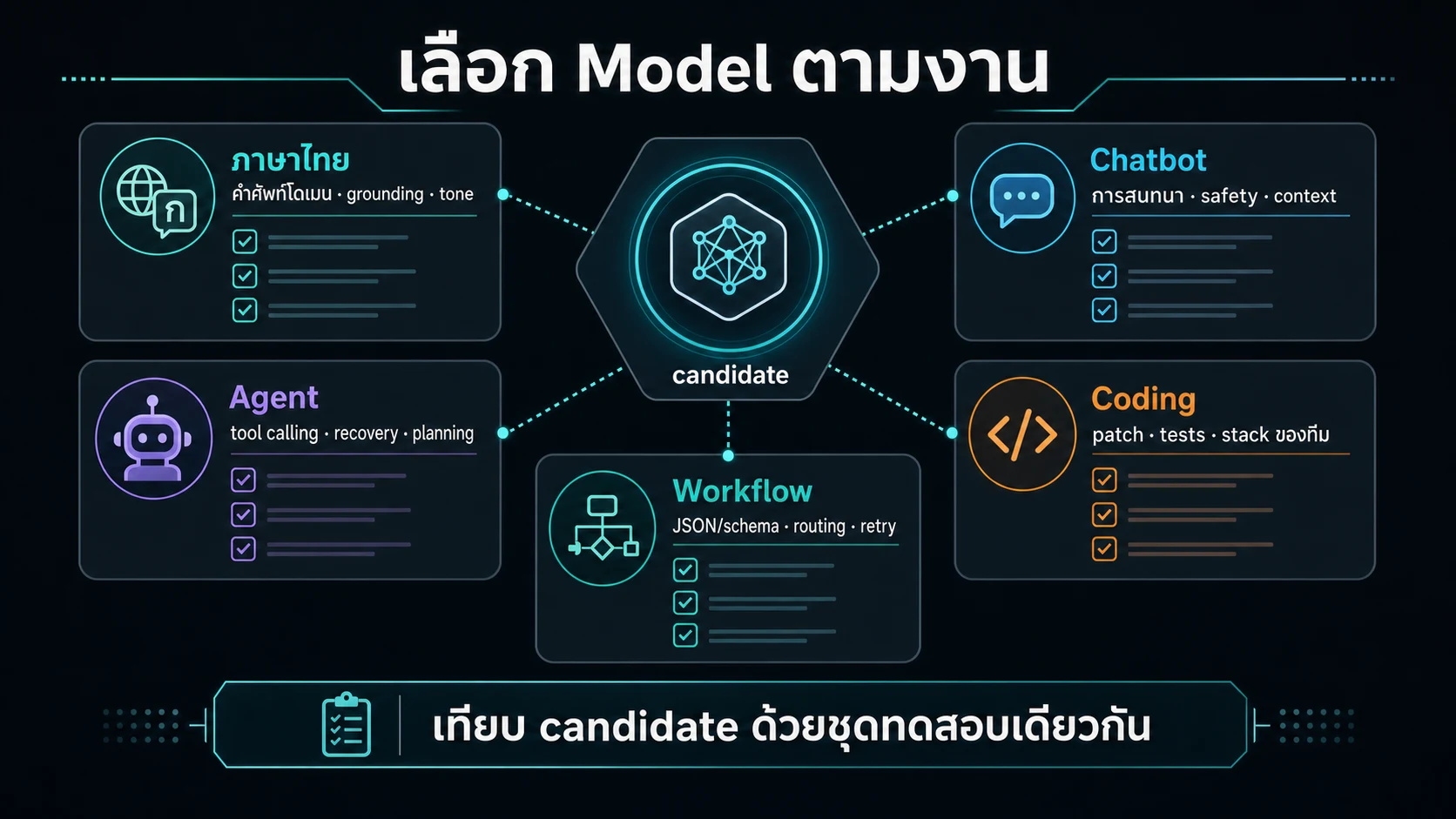
USE IT ON REAL WORK
Use one scorecard for every candidate
A model name does not tell you whether it suits the work. Build a small evaluation set from real prompts, tools, documents, and user-visible failures.
Pass the quality bar first, then compare memory and tok/s in one runtime. That leaves an explainable selection record.
| Work | Pass criterion | Failure case to include |
|---|---|---|
| Thai | Correct instructions, tone, and domain terms | Ungrounded answer or wrong term |
| chatbot | Coherent context-aware replies | Topic loss across turns |
| agent | Tool calls match the schema | Cannot recover from a tool error |
| coding | Patch passes relevant tests | Regression outside the intended change |
| workflow | JSON matches schema and retries | Missing field or wrong type |
A minimum evaluation pack
- Ten Thai prompts from real work
- A multi-turn conversation with source documents
- One malformed tool result
- A code change with test feedback
- Structured output with invalid JSON and retry
{
  "ticket_id": "string",
  "category": "billing | support | security",
  "needs_human": true
}
Thai language
Evaluating models for Thai workloads requires direct testing on your actual tasks, not simply checking if the model emits Thai sentences:
- Thai Instruction Following: Verify that the model comprehends multi-constraint instructions in Thai without losing context or defaulting back to English.
- Retrieval Grounding (RAG): Ensure the model answers questions strictly from provided Thai reference documents without hallucinating facts.
- Policy Tone and Domain Terms: Validate tone appropriateness (formal, business, colloquial) and industry-specific vocabulary across legal, medical, or financial domains.
- Benchmarks and Sources: Model cards like ThaiLLM-8B offer a useful starting point, but they cannot replace direct empirical testing against your company's daily workload prompts.
Chatbot and agent
Distinguishing between basic conversational chatbots and autonomous AI agents ensures you select the proper model capabilities:
- Chatbots: Prioritize natural conversational flow, polite demeanor, robust safety guardrails, and long-context retention across multi-turn dialogs.
- AI Agents: Prioritize rock-solid **Tool Calling / Function Calling** the model must reliably translate user intent into structured JSON arguments conforming strictly to external API schemas.
- Error Recovery: When an external tool returns an error, the agent must diagnose the issue, adjust its strategy, and retry gracefully without stalling in an infinite loop.
Always evaluate agents against complex, multi-step failure scenarios rather than single-turn prompts.
Coding and structured workflow
Technical and programmatic workloads demand strict logical and syntactic precision:
- Coding: The model must excel in your team's specific language stack (Python, TypeScript, Go, SQL), produce patches that pass regression test suites, and iteratively fix bugs from compiler or test feedback.
- Structured Workflows: Data extraction, routing, and backend integrations require 100% compliant JSON or XML output.
- Schema Validity: An ideal workflow model closes all JSON brackets, adheres strictly to field data types, and supports deterministic retries without schema drift.
Remember: A model that writes eloquent conversational prose is not necessarily the most reliable model for strict structured data extraction!
Memory floor and deployability
A highly capable model that cannot fit into your hardware's available VRAM is unusable in production:
- Calculate the Memory Floor: Sum the model weight footprint (based on quantization bit width) with the KV Cache memory required for your target context length and concurrency.
- Shortlist 2-4 Candidates: Pick realistic candidate models that fit comfortably within your GPU VRAM headroom (for example, comparing 14B-32B models in 8-bit or 4-bit on a 24 GB GPU).
- Compare with Unified Criteria: Run candidates through the LLM VRAM Calculator and an identical evaluation test suite to balance hardware cost, tok/s speed, and task quality before rolling out.
Sources
Try your configuration
Put the intended model, quantization, context, framework, and hardware into the calculator, then validate with a production-like benchmark.
Open calculator